Showing Up and Standing Out: Presence, Confidence and Communication
How do emerging leaders develop the presence to command attention, the confidence to act and the communication skills to make themselves understood?
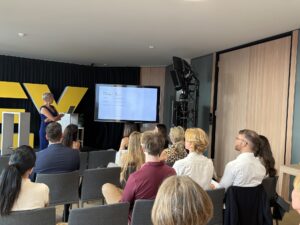
These questions were at the heart of a practical workshop for the first cohort of the British Chamber of Commerce for Luxembourg’s Emerging Leaders mentoring group. Held on 7 July 2026 and generously hosted by EY Luxembourg, the session was led by Lola Kaneva-Goggins and Camelia Pavel, members of the People and Leadership working group, with opening remarks from Emerging Leaders Chair Juan Gasca.
The workshop began with a reassuring premise: leadership is learned, not inherited. Composure under pressure, self-belief and the ability to influence others are behaviours – and behaviours can be practised.
Presence: arriving before you speak

The first section explored how people experience us before we have said a word. Participants adjusted their posture, relaxed their shoulders and imagined entering an important meeting. Drawing on the work of Amy Cuddy and Herminia Ibarra, the discussion highlighted an important shift: rather than waiting to feel like a leader, we can practise leadership behaviours and grow into the identity.
In the ‘Showing Up Under Pressure’ exercise, participants drafted the first sentence they would use when confronted with a difficult question. The lesson was simple: presence is not about answering immediately. Pausing, listening and responding deliberately often communicate more credibility than rushing or filling every silence.
Confidence: evidence built through action

The second section challenged the assumption that confidence must come before action. Drawing on Albert Bandura’s theory of self-efficacy and Carol Dweck’s work on growth mindset, Camelia explained that confidence develops through mastery experiences: we act, learn and repeat until experience gives us reason to trust ourselves.
During ‘Borrow Confidence from Your Past’, participants revisited something that had once felt impossible but had since become part of everyday life. Working in pairs, they identified strengths within those stories, including resilience, courage, persistence and judgement. The exercise showed how readily people recognise capability in others while overlooking the evidence in their own experience.
Communication: being understood matters more than being right
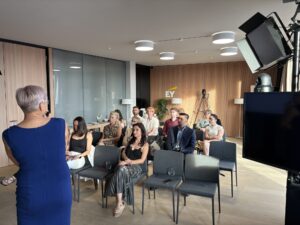
The final section addressed conversations people postpone because they feel uncomfortable or risky. Drawing on the work of Douglas Stone, Bruce Patton and Sheila Heen, the group considered the facts, feelings and questions of identity present in every difficult conversation. Daniel Kahneman’s work offered a further reminder: being right is rarely enough; communication succeeds when the message is understood.
In the ‘Say It Anyway’ exercise, participants identified a conversation they had been avoiding, considered the cost of continued silence and drafted a simple opening sentence. Speaking up, they discovered, does not require a perfect script – only the courage to begin. The discussion also reinforced two practical lessons: ask for help when needed, and never assume others already know what you think or need.
Three capabilities working together
Lola brought the themes together: presence opens the door, confidence keeps you in the room and communication makes you understood. Participants left with three commitments: one room they would enter differently, one capability they would deliberately build and one conversation they would stop avoiding.
The evening concluded with drinks, nibbles and networking on EY Luxembourg’s rooftop terrace. Above all, the workshop left participants with a powerful reminder: the room needs their contribution far more than it needs their perfection.